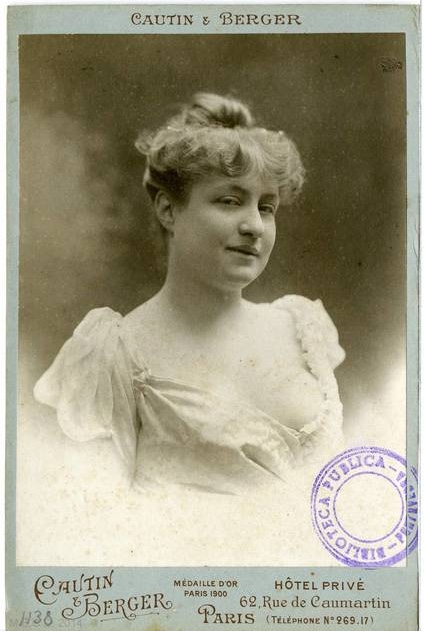
Durand (1864-1936) was a contradiction. Beautiful, talented – but political and forceful – she was aware of the change coming for women’s rights in Paris and the world. She used her beauty and intelligence to change the course of feminism in late 19th century – Paris in particular. Her appearance was at odds with many other feminists, but she was no less serious about her beliefs. Marguerite had a traditional convent education in Paris, her mother raised her alone – never marrying. Durand then became a popular actress at the Comédie Française in Paris, but left the stage to marry an up-and-coming young politician/lawyer -Georges Laguerre. He defended many from the lower classes – and feminists such as Louise Michel – who was also a major figure in the Paris Commune.
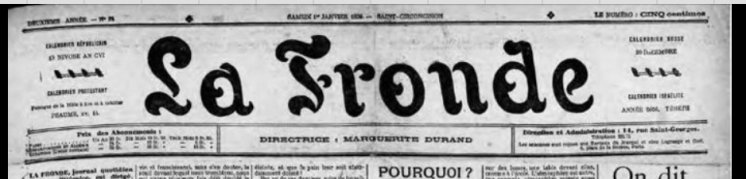
After a separation Durand and Laguerre divorced. Marguerite was then hired by Le Figaro – one of the most prestigious newspapers of the day. She began by writing a “woman about town” column. But, after covering an International Feminist Conference held in Paris, she was converted to the feminist cause and was encouraged to start a female run newspaper – La Fronde – which she did very successfully.
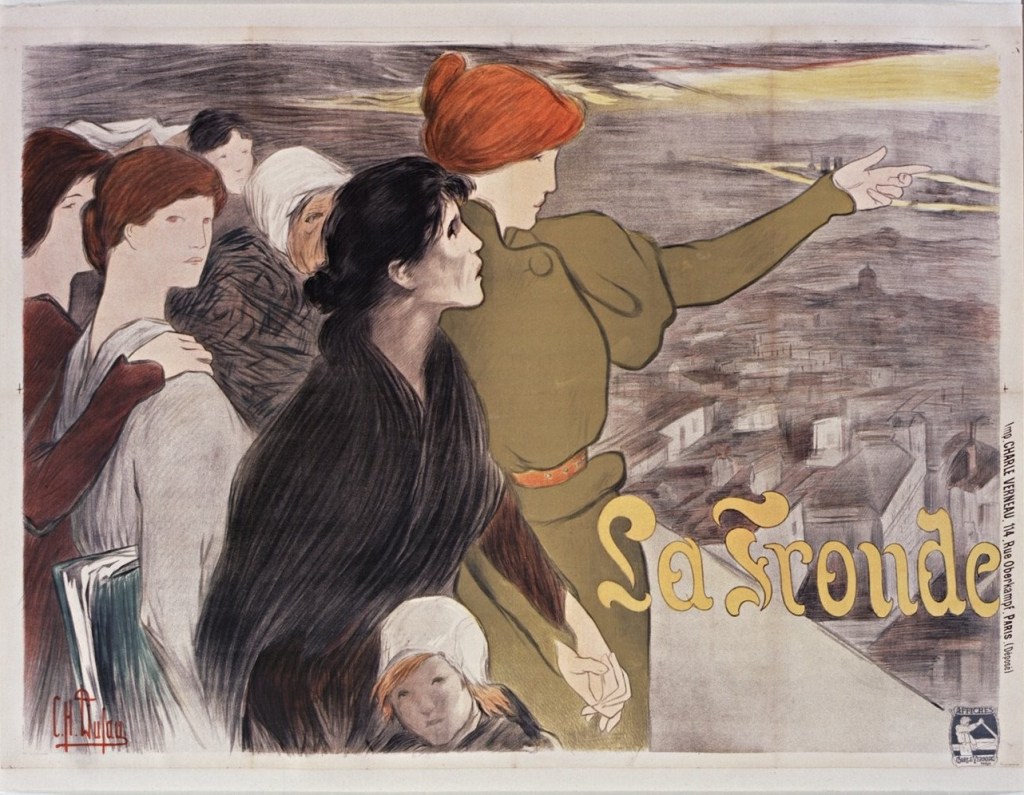
Durand even commissioned a poster from a Parisian artist, Clémentine-Hélène Dufau, to publicize her newspaper.
I am writing a dual-time line novel about her life, but since there are many gaps in what is known of her life, it will invariably need to include some fictional details. For the first third, the chapters go back and forth between Durand’s life and a researcher from America who is using her library during the years 1935-36. Then the book jumps to 1973, and follows a researcher from Le Figaro, and a young woman (the daughter of the woman who was researching in 1935-36), now researching La Fronde.
Durand’s portion (from her birth to her death, 1864-1936) is comprised of letters, some real and some created, as well as letters to her – from friends (i.e. Severine, her mother,, etc…. ) There also exist telegrams, newspaper accounts, reviews of her acting career – and these will be included.
The other side of the time line, set in 1973, features the two researchers noted above working in the library founded by Durand in 1932. This library still exists today. One researcher is a young man from Le Figaro writing an article on Durand’s library, and the other is an American woman (the daughter of the researcher from 1935-36) writing her dissertation on La Fronde – the newspaper founded by Durand and produced solely by women. The researchers meet in the library and discover that both of their mothers had a connection to Durand. They both end up trying to find her letters that she supposedly destroyed – letters that both believe will fill in the many gaps in the history of her life.
The chapters go back and forth between the two time lines. There are conflicting accounts of much of her life – which is a good thing for someone writing fiction. I am using the known facts for much of the book, but the times where there is little known – i.e. her time being raised by her mother and a sculptor, her time as a young girl in a convent school, and funding for La Fronde in particular. To fill in the gaps in her history, I will be creating letters that I believe could be what she, and others, would have written.
Marguerite Durand is a fascinating person of many contradictions….which makes her all the more interesting. She deserves to be more well-known. I hope to take you on a journey across time to know her better.

