War and Politics
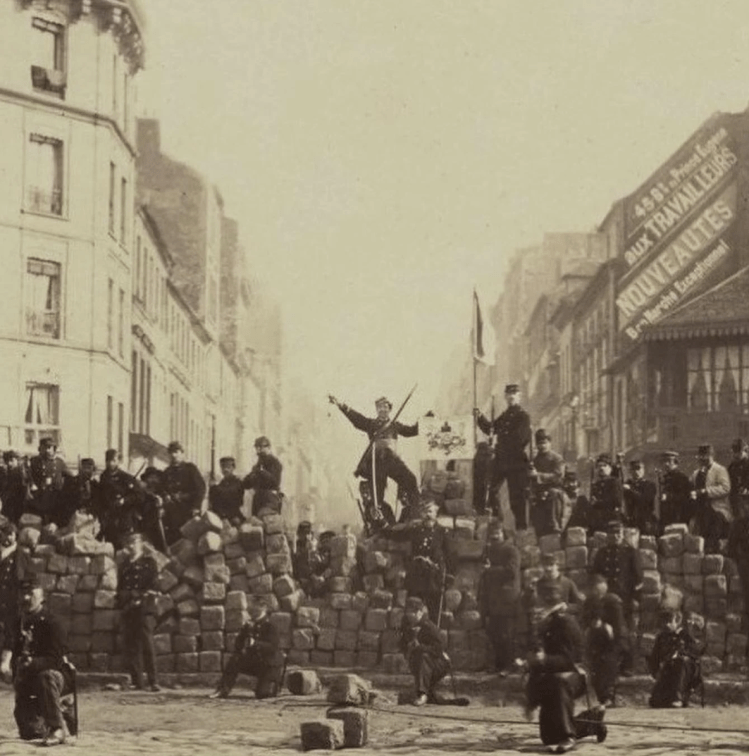
Bibliothèque Nationale, Paris.
The 1880s was less than ten years after three defining events for the city, and really the country as a whole.
The Paris Commune was short lived, three months in 1871. It was a French revolutionary government that seized power in Paris from 18 March to 28 May 1871. During the Franco-Prussian War of 1870–71, the French National Guard had defended Paris, and working-class radicalism grew among its soldiers. Many of the working class were empowered to change the government – they met in cafes, churches and in their homes. The Commune governed for two months – their policies included the separation of church and state, self-policing, the remission of rent, the abolition of child labor, and the right of employees to take over an enterprise deserted by its owner. All Roman Catholic churches and schools were closed. Feminist, Socialist and Communistic ideas played important roles in the Commune. However, the various Communards had little more than two months to achieve their respective goals.
The national French Army suppressed the Commune at the end of May during La semaine sanglante (“The Bloody Week”) beginning on 21 May 1871. The national forces killed in battle or quickly executed between 10,000 and 15,000 Communards, though one unconfirmed estimate from 1876 put the toll as high as 20,000. In its final days, the Commune executed the Archbishop of Paris, Georges Darboy, and about one hundred hostages, mostly gendarmes and priests. 43,522 Communards were taken prisoner, including 1,054 women. More than half were quickly released. Fifteen thousand were tried, 13,500 of whom were found guilty. Ninety-five were sentenced to death, 251 to forced labor, and 1,169 to deportation. All the prisoners and exiles received pardons in 1880 and could return home, where some resumed political careers.
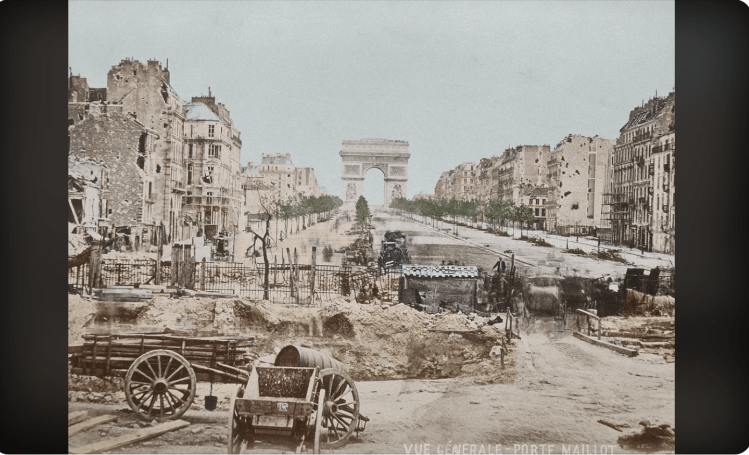
The Franco-Prussian War (July 1870-May 1871) left many of its soldiers, if not dead, disabled in not only body but mind. The years after the war saw the rise of the specialty – Medical Alienation – that sought to treat mental disorders by more humane methods. Previously, asylums were mainly places were patients were sent, often chained and abused, and never recovered. The doctor responsible for a change to more humane methods was Philippe Pinel. He was a French physician and precursor of psychiatry and was instrumental in the development of a more humane psychological approach to the custody and care of psychiatric patients, referred to today as moral therapy.
The Siege of Paris (September 19, 1870 – January 28, 1871), at the end of the Franco-Prussian War, was short but horrific. The characters in my mystery all lived through it – in various occupations: the police, the church and the army. The residents of the city were basically starved by the Prussian/German forces, and as food ran out they ate horses, pets, and even some of the animals in the Zoological Garden. Although curiously, the monkeys were not eaten, thanks to Charles Darwin’s recent work on evolution – they were considered too close to humans to be considered for food.
Further Reading –
Franco-Prussian War –
King’s College London: https://www.kcl.ac.uk/the-franco-prussian-war-150-years-on
Chemins de Mémoire: https://www.cheminsdememoire.gouv.fr/en/franco-prussian-war-1870-71
Google Arts & Culture: this site has over ninety images – paintings, prints and photographs – illustrating aspects of the war
https://artsandculture.google.com/entity/franco-prussian-war/m0c0dv?hl=en

